
Arakan News Agency
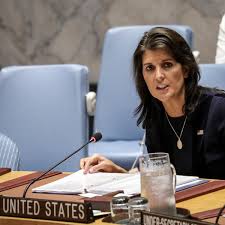
Nikki Haley, the United States permanent representative to the United Nations, is expected to visit Rohingya camps in Cox’s Bazar as part of a delegation of the United Nations Security Council to assess allegations of ethnic cleansing and genocide against minority Rohingya community in Arakan of Myanmar.
The UN was working with both the Bangladesh and Myanmar authorities for setting a date for the visit to both sides of the border, diplomats said.
There was a possibility of the visit of the high profile UNSC delegation on April 27 and 28, diplomats said, adding that the date might change.
‘We are currently preparing the terms of reference,’ UNSC president for April Peruvian ambassador Gustavo Meza-Cuadra told reporters in New York on Monday, according to Voice of America.
‘We do have the readiness of the government of Myanmar to agree to the visit, to accept the visit; obviously, we are interested in the Arakan state,’ he said.
‘In really maintaining interest in this topic, there is nothing better than making a visit on the ground to see how the situation is really,’ Meza-Cuadra said.
When his attention was drawn to the possibility of the visit of Nikki Haley, the US chargé d’affaires in Dhaka Joel Reifman told on Wednesday that it would be a welcome visit.
He said this after a meeting with foreign secretary M Shahidul Haque at the foreign ministry.
Five permanent members of the UNSC are China, France, Russian Federation, the United Kingdom, and the United States.
Ten non-permanent members, elected for a two-year term by the UN General Assembly, are Bolivia, Côte d’Ivoire, Equatorial Guinea, Ethiopia, Kazakhstan, Kuwait, the Netherlands, Peru, Poland and Sweden.
UN high commissioner for human rights Zeid Ra’ad al-Hussein stressed the need for referring suspected ‘acts of genocide’ committed against minority Rohingya community to the International Criminal Court for prosecution.
Yanghee Lee, UN independent investigator on human rights in Myanmar, observed that there was growing evidence to suspect genocide was committed and wanted prosecutions for crimes committed against entire ethnic and religious groups, according to a report published on Friday.
The Hague-based ICC has the jurisdiction to prosecute individuals of a country, which is a party to the Rome Statute, for crimes of genocide, crimes against humanity and war crimes, only when certain conditions are met.
The conditions include, among others, unwillingness and [or] inability of national courts to prosecute criminals. The ICC requires a referral from the United Nations Security Council for prosecuting individuals of a country which is not party to the Rome Statute.
The case of atrocities committed against Rohingyas would require a referral from the UNSC as Myanmar is not a party to the Rome Statute. About 123 UN member states are party to the Rome Statute.
Over 6,88,000 Rohingyas, mostly women, children and aged people, entered Bangladesh fleeing unbridled murder, arson and rape during ‘security operations’ by Myanmar military in Arakan, what the United Nations denounced as ethnic cleansing, since August 25, 2017.
The last Rohingya influx took to 11.07 lakh the number of Myanmar people living in Bangladesh, and exodus from bordering Arakan State continued till Monday.
Bangladesh and Myanmar signed three instruments in last four months for return of Rohingyas subject to verification by Myanmar authorities, within two years of transferring the first batch of over 7,73,000 Rohingyas who crossed the border since October, 2016..3


