
Arakan News Agency
Tough sanctions, relentless pressure on its military dictators and worldwide support for charismatic political dissident Aung San Suu Kyi finally prodded Myanmar, the Southeast Asian country also known as Burma, to embrace democracy in 2012.
As President Barack Obama put it during a 2012 visit to Myanmar, “To those who cling to power through corruption and deceit and the silencing of dissent, know that you are on the wrong side of history, but that we will extend a hand if you are willing to unclench your fist.”
It may be time to withdraw that hand — or even use it to deliver a slap — if that’s what it takes to force Myanmar’s military government to prevent the systematic extinction of the Rohingya, a little-known Muslim minority in this majority Buddhist nation.
Human rights groups call it a case of impending genocide, and they don’t make that charge lightly. According to the United Nations, news reports and the U.S. Holocaust Memorial Museum based in Washington, D.C, the Myanmar government refuses citizenship to the Rohingya, forces them to live either in ghettos or displacement camps that are threatened by violence and does little to counter anti-Muslim propaganda.
The independent U.N. Special Rapporteur for Human Rights, Tomás Ojéa Quintana, appointed to study human rights in Myanmar, told an audience in London last year that, “There are elements of genocide in Rakhine with respect to Rohingya.” That’s a chilling warning that should not be ignored.
About 800,000 Rohingya live in Myanmar’s Rakhine state, which borders India and Bangladesh — a place that some of them have called home for decades, although Buddhist extremists deride them as Bengalis.
In 2012, the Rohingya clashed with Buddhist groups in Rakhine, a poverty-stricken state where the fight for resources is keen. Buddhist mobs destroyed Rohingya homes, killing those who could not outrun the violence, according to an investigation by the United Nations. Hundreds were killed and 140,000 people were displaced.
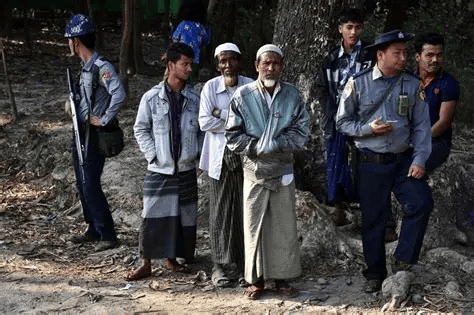
Now, many either live in ghettos surrounded by barbed wire and barricades or in deplorable camps guarded by soldiers who sometimes prevent humanitarian workers from entering them, according to the U.N. investigation and reporting by Newsweek.
Even more frightening, a report by the U.S. Holocaust Memorial Museum warns that the Myanmar government controls all facets of Rohingya life, engaging in the kind of systematic oppression that has been a precursor to genocides elsewhere.
Source :cleveland


