Arakan News Agency
Excellency,
We write on behalf of Human Rights Watch to urge you to support a strong item 4 resolution on the human rights situation in Myanmar at the upcoming 34th Session of the United Nations Human Rights Council, renewing the mandate of the Special Rapporteur, engaging with the reform benchmarks requested of the Special Rapporteur by HRC resolution 31/24, and establishing an independent, international investigation into alleged violations and abuses in Arakan State.
This resolution is necessary in light of the serious human rights crisis faced by ethnic Rohingya Muslims in northern Arakan State; international human rights and humanitarian law violations in Kachin and Shan States; increasing numbers of political prisoners as the result of the prosecution of critics of the government and peaceful protesters; and other serious rights violations.
We urge the Human Rights Council to establish an independent, international investigation into alleged abuses perpetrated in Arakan State following the October 9, 2016 attacks by militants on state security forces. Human Rights Watch has documented widespread and serious abuses against Rohingya civilians by the security forces, including extrajudicial killings, systematic rape and other sexual violence, and the burning of numerous Rohingya villages.
The need for an international investigation is clear in light of the government’s continued failure to carry out credible investigations of its own. On December 1, the government announced the creation of a committee to investigate the situation in Arakan State and to report by January 31, 2017. However, the committee’s composition and mandate raised serious doubts that it would conduct a thorough and impartial investigation into alleged abuses. The committee’s interim report, released on January 3, dismissed allegations of rape, rejected evidence of serious abuses and religious persecution, and said there were no cases of malnutrition—contrary to the findings of the UN, Human Rights Watch, and others. On January 31, a statement issued by the Myanmar President’s Office said the committee had requested more time before submitting its final report. No new deadline has been set. On February 6, the UN Special Adviser on the Prevention of Genocide said that the scale of violence against the Rohingya community reflected “a level of dehumanization and cruelty that is revolting and unacceptable,” and underlined that the government-appointed committee is “not a credible option” to carry out investigations.
At a minimum, the HRC resolution should:
- Renew the mandate of the Special Rapporteur on the situation of human rights in Myanmar under item 4 for a further period of one year;
- Establish an independent, international investigation into allegations of human rights violations in Arakan State, including reports of extrajudicial killings, enforced disappearances, rape and other sexual violence, arbitrary arrests, burning and destruction of houses, forced displacement, and other serious violations;
- Call on Myanmar authorities to:
- Cooperate fully with the Special Rapporteur and members of the international investigation, authorize them to conduct visits to the country, and provide them with unfettered access to all areas of the country necessary to carry out their mandate;
- Cooperate fully with the Office of the High Commissioner for Human Rights, including by keeping its 2012 commitment “to extend an invitation to the UN High Commissioner for Human Rights to establish an office in Myanmar.” The office should have a full protection, promotion, and technical assistance mandate;
- Immediately cease abusive tactics by the security forces, especially in northern Arakan State during “clearance operations” and in Shan and Kachin States;
- Immediately allow unfettered access by humanitarian organizations to provide assistance to all areas in need in Myanmar, in particular northern Arakan State, and to all areas of Shan and Kachin states;
- End restrictions on access to humanitarian assessment teams, journalists, and independent human rights observers in all areas of Myanmar, in particular Arakan, Shan and Kachin States;
- End the persecution of the Rohingya, including by amending the discriminatory provisions of the 1982 Citizenship Law;
- End restrictions on freedom of movement that severely impact the rights to health care and livelihood of Rohingya in Arakan State and facilitate the return of the 120,000 still-displaced persons from the 2012 violence that amounted to ethnic cleansing;
- Repeal the four discriminatory, anti-Muslim race and religion laws;
- Release all political prisoners;
- End the use of criminal law, such as section 66(d) of the Telecommunications Act and sections 141-147 and 505 of the Penal Code, to prosecute and imprison individuals for peaceful speech and assembly;
- Repeal or amend other laws, as appropriate, to conform to international standards for the protection of the rights to freedom of expression, association, and peaceful assembly, and other fundamental rights;
- Reform the prisons so that the treatment of detainees and prisoners conform with international standards; and
- Continue to take credible steps to address the harmful human rights and development impacts of widespread land confiscations under the previous military governments.
- Engage with the benchmarks report requested of the Special Rapporteur by the Human Rights Council in its resolution 31/24, and request that the Special Rapporteur work with the government to develop an implementation plan to meet the reform benchmarks.
The annex to this letter provides more information on Human Rights Watch’s research findings and our key human rights concerns.
Thank you for your consideration. We stand ready to answer any questions and look forward to your support at the 34th Session of the Human Rights Council in order to safeguard the rights of all people in Myanmar and support progress toward meaningful human rights reform.
The following is a short summary of key human rights concerns in Myanmar. It is not exhaustive and the omission of any issue does not mean that Human Rights Watch does not think it is important.
Abuses Against Rohingya
The United Nations, Human Rights Watch and other human rights organizations, and the media have reported on widespread and serious abuses against Rohingya by government security forces throughout northern Arakan State. Human Rights Watch has documented burnings of numerous Rohingya villages, extrajudicial killings, and systematic rape and other sexual violence. Because northern Arakan State remains closed to independent journalists and human rights investigators, the full extent of the abuses is unknown.
Since the current spate of violence, which erupted after Rohingya militants attacked Border Guard Police posts in early October 2016, killing nine security personnel, satellite imagery analyzed by Human Rights Watch has identified at least 1,500 buildings that were destroyed in Maungdaw township between October and November last year. The burn scars were consistent with arson attacks, while the pattern of destruction strongly suggested that the buildings were destroyed as part of a military operation. Eyewitness accounts have placed accountability for the burnings squarely with the military.
Villagers described to Human Rights Watch seeing Myanmar military personnel burn their homes one by one, drag family members from their homes and shoot them, and rape women and girls. A number of women interviewed by Human Rights Watch described being the victim of gang rapes by members of the military.
The humanitarian crisis in northern Arakan State deepens each day that access to highly vulnerable and food insecure populations is not fully restored. It is crucial that the Human Rights Council publicly press for the resumption of regular and uninterrupted aid deliveries. While the Myanmar government repeatedly gave its assurances that it would allow for the full resumption of aid to impacted areas, aid has only trickled in, deepening the crisis for an already vulnerable population. The World Food Programme (WFP) reported on December 29 that “severe food insecurity appears highly widespread.” On January 13, 2017, the delivery of emergency food assistance was permitted to 158 affected villages in northern Maungdaw, with some 35,000 reportedly reached by January 30. International staff has not been allowed to conduct distributions. Neither the WFP nor the Office for the Coordination of Humanitarian Affairs (OCHA) has been able to conduct a comprehensive needs assessment across the impacted areas in northern Maungdaw, and thus can only estimate the number of people currently in need of humanitarian assistance.
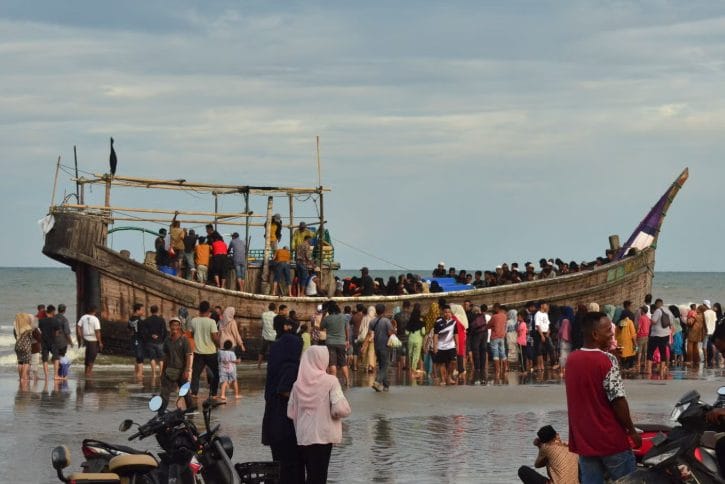
Massive displacement has been an enduring product of the recent violence and deteriorating conditions. As of January 31, the UN estimates that at least 92,000 have fled their homes. More than 23,000 (over 12,300 women and girls) remain displaced within northern Maungdaw township. Another 69,000 have fled to neighboring Bangladesh.
Beyond addressing immediate human rights and humanitarian concerns, it is important that the HRC resolution call on the union and state governments to cease persecution of the Rohingya population. The 1.2 million Rohingya in Myanmar have long been targets of government discrimination, which has been facilitated by their effective denial of citizenship under the 1982 Citizenship Law. This law should be amended to meet international standards or repealed. The extension and long-term maintenance of curfew orders in northern townships such as Maungdaw and Buthidaung are also a matter of significant concern, and should be rescinded. Restrictions on freedom of movement severely limits rights to livelihood and health, while access to formal education has historically been restricted.
Human rights and humanitarian concerns for the more than 120,000 persons still displaced and in camps after the ethnic cleansing that took place in 2012 should also be addressed. There are nearly 100,000 displaced persons living in squalid conditions within camps within Sittwe alone that have seen little improvement in their lives over the past four years. Continued restrictions on movement prevent people from gaining access to livelihood opportunities, making them dependent on humanitarian aid.
Without resolving these core issues, the rights of the Rohingya population will continue to be violated—it is not enough for the government to simply cease its current abusive tactics.
Continued Criminalization of Peaceful Expression
The authorities in Myanmar continue to use broad and vaguely worded laws to prosecute and imprison individuals for peaceful expression. Prosecutions for “criminal defamation” against those who criticize or “insult” the military or the government have soared since the current government took office. More than 40 such cases have been filed during the past year under section 66(d) of the 2013 Telecommunications Act, which criminalizes defamation on the Internet with a penalty of up to three years in prison. Those facing charges under the law are not entitled to bail, and many are detained for months pending trial.
In recent months, one man was sentenced to nine months in prison for calling President Htin Kyaw an “idiot” and “crazy,” while another was sentenced to two years in prison for posting digitally altered images of the military’s commander-in-chief on social media. Other pending cases include prosecutions for criticizing the military’s actions against Rohingya Muslims in Arakan State, criticizing Aung San Suu Kyi, and “slandering” a municipal official. On January 25, 2017, nine high school and university students were charged with criminally defaming the military in a play that satirically criticized those who support the ongoing conflict between the Myanmar military and ethnic armed groups.
Myanmar’s colonial-era Penal Code also continues to be used to prosecute peaceful expression. Authorities have charged activist Khine Nyo Htun with making statements that could “alarm” the public and “incitement,” in violation of sections 505(b) and 505(c) of the Penal Code, for statements he allegedly made accusing the military of committing war crimes in Arakan State. Khine Nyo Htun, who has been denied bail since his arrest in July 2016, faces up to two years in prison on each charge. Veteran activist Htin Kyaw has been charged with making a statement “that may impede a member of the Tatmadaw [army] in the execution of their duty,” in violation of section 505(a) of the Penal Code for statements criticizing the military.
Those exercising their right to peaceful assembly also continue to be arrested and prosecuted. In May 2016, the police arrested more than 70 factory workers who were marching from Sagaing to Naypyidaw to protest working conditions. Fifty-one were charged with unlawful assembly, riot, and making statements that could alarm the public under sections 143, 147, and 505(b) of the Penal Code. While some were later released, fifteen workers were sentenced to prison, and others are still awaiting trial.
Race and Religion Laws
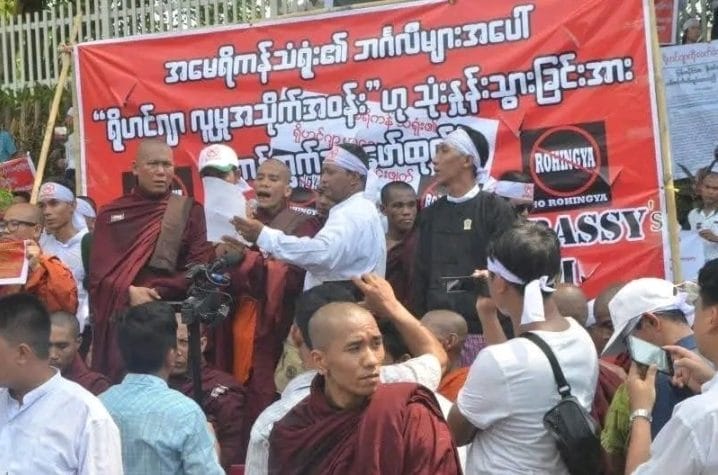
In 2015, the Buddhist-monk-led Association for the Protection of Race and Religion, known as Ma Ba Tha, successfully urged the government to draft four so-called race and religion protection laws: the Population Control Law, the Buddhist Women’s Special Marriage Law, the Religious Conversion Law, and the Monogamy Law, all of which were subsequently enacted.
The four laws are discriminatory and violate religious freedom by, for example, creating special rules for Buddhist women who marry—or seek to marry—non-Buddhist men; introducing vaguely defined acts against Buddhism as grounds for divorce, forfeiture of child custody and matrimonial property, and potential criminal penalties; and empowering authorities to limit the number of children that members of designated groups can have. The religious conversion law enables the state to regulate religious profession and conversion, a wholly unjustified state interference in the right to freedom of conscience and religion. These laws imperil religious freedom of all religious minorities in the country and need to be repealed.
Source : Human Rights Watch