Arakan News Agency
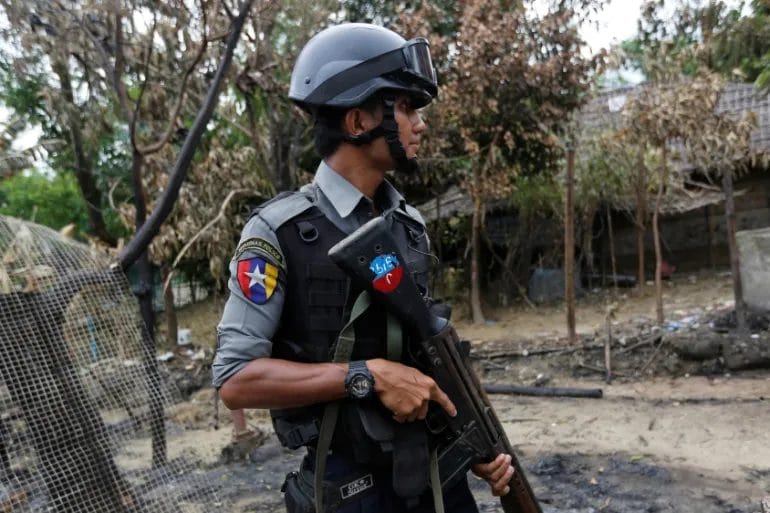
Myanmar police said yesterday they had opened fire on a crowd of ethnic Rakhine Buddhists as they tried to seize a government office, in unrest that left seven dead in a state already scored by violence and divisions.
The incident unfolded as about 5000 Buddhists gathered late on Tuesday for a nationalist ceremony in Mrauk U, a town that has so far remained unscathed by the military’s crackdown on the region’s minority Rohingya Muslim community.
It was not immediately clear why the rally descended into violence. But ethnic Rakhine have a longstanding enmity with the Myanmar state which is dominated by ethnic Bamar.
The clashes also came on the same day as a repatriation agreement was signed between Myanmar and Bangladesh to start the return of about 700,000 Muslim Rohingya refugees from squalid camps back over the border.
The UN has demanded access to Arakan. UN agencies, aid groups and many of the refugees have expressed deep misgivings about the plan.
They fear that it would transfer the displaced masses from one set of miserable refugee camps, where they are at least safe, to even worse conditions in Myanmar, where they would be vulnerable to persecution by the security forces that expelled them.
The Bangladesh government, which is jointly responsible for the plan, announced the transfer would be completed within two years, after its start next Tuesday. The aim is to establish five transit camps in Bangladesh from which refugees would be sent to two “reception centres” across the river border in Myanmar.
Myanmar officials have said that they will soon begin processing at least 150 people a day. But almost all Rohingya say that without the promise of citizenship and security guarantees overseen by the UN, they are determined to stay on the safe side of the border.
The presence of foreign observers or peacekeepers would not be tolerated by Yangon. Even international aid agencies are allowed only the most restricted access to Arakan.
Andrej Mahecic, a spokesman for the UN High Commissioner for Refugees, said: “We and our partners need urgent, unhindered access in Arakan state in order to assess the situation and provide support to those in need and to help with rebuilding efforts.
“Major challenges include ensuring that refugees are informed about the situation in their areas of origin and potential return and consulted on their wishes; that their safety is ensured throughout; and that the environment in the areas of return is conducive for safe and sustainable return.”
About 700,000 Rohingya have crossed the border into Bangladesh since late August, when small-scale attacks by Rohingya militants provoked massive reprisals by the Myanmar army, police and civilian vigilantes. The response has been described by the UN as “a textbook example of ethnic cleansing”.
After another ethnic cleansing, in 2012, about 140,000 Rohingya from the south of Arakan were placed in squalid camps where they have remained ever since, deprived of the opportunity to work, attend schools or receive adequate healthcare.
The situation in the camps in Bangladesh is deteriorating after an outbreak of diphtheria.
“As we get closer to the cyclone and monsoon seasons, what is already a dire humanitarian situation risks becoming a catastrophe,” said Edouard Beigbeder of UNICEF. “Hundreds of thousands of children are living in horrific conditions and they will face an even greater risk of disease, flooding, landslides and further displacement.”