
Arakan News Agency
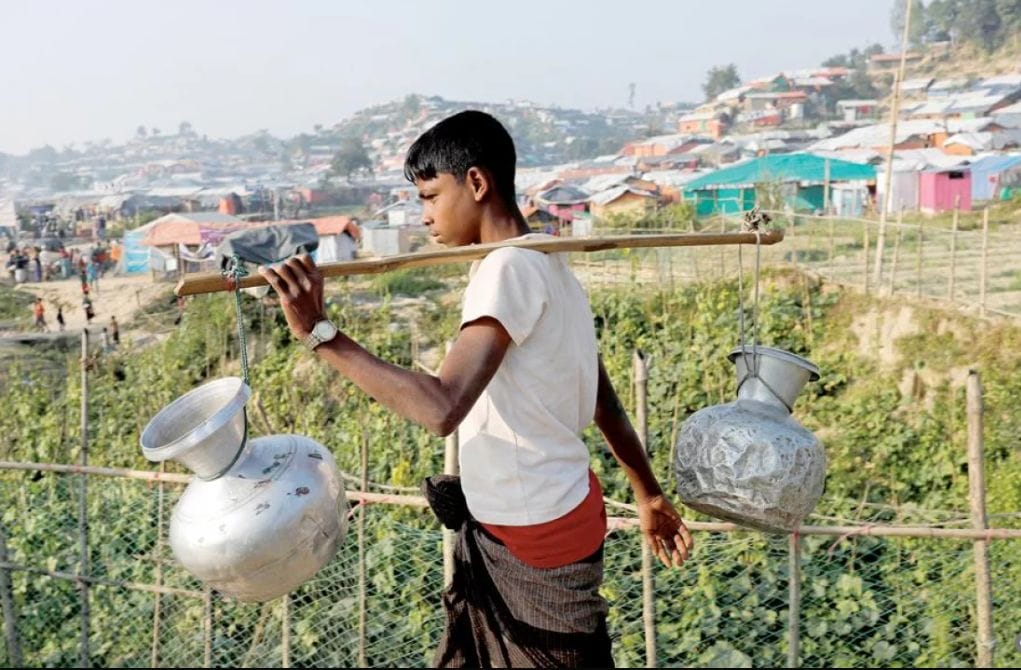
Médecins Sans Frontières (MSF) has said living conditions for Rohingyas need to be massively improved with a particular focus on improvements to water and sanitation, shelter, reducing population density.
In a press release, the non-profit organization pointed out that there is an urgent need for a better response from organizations providing healthcare to mitigate the risk of additional diseases spreading in the camps.
The statement said it has to be ensured that all those who need vaccinations receive them.
The MSF data reveals that water sources are insufficient in the camps in Cox’s Bazar and often polluted with sewage, latrines are not deep enough, and no provision has been made for a drainage system.
The data shows that latrines and water sources in almost all camps are set up near to each other, easily resulting in contamination.
According to the World Health Organization report, some 91% of households and 60% of source samples were found to be contaminated with Escherichia coli (E coli) in the refugee camps.
Due to the lack of a drainage system, stagnant water is present around a quarter (26%) of all tube wells. As for sanitation, 39% of emergency latrines installed by WASH partners, mostly at the early stage of the emergency response are non-functional.
The MSF is prioritizing measures such as de-sludging and decommissioning these latrines for improve the inadequate sanitation environment.
The WASH (Water and Sanitation) cluster, supervised by the MSF is doing sanitation survey and water point survey in order to decommission the facilities where the risk is highest.
As of January, 2018 the MSF has built 1,522 latrines, 218 water wells and a gravity water supply system both in the settlements located in the North as well as in the ones in the South.
MSF also plans to drill 20 wells down to the water table and use submersible pumps in Tasnimarkhola and Balukhali.
In response to Hepatitis E cases, MSF has done assessment of water sources, soap distribution in roughly 800 households, hygiene promotion messaging and bucket chlorination at water source.
To ensure access to clean drinking water, the MSF plans to distribute domestic water filters in clinics run by the organization in Tasnimarkhola and Balukali for patients of malnutrition, measles and pregnant women.
According to a MSF report, a total 3,539 cases of measles were reported across all the MSF health facilities from September, 2017 to January this year.
However, the organization said the epidemiological curve of measles is decreasing significantly.
The MSF has also treated more than 4,371 cases of diphtheria as of 22 January this year.
At least 688,000 Rohingyas entered Bangladesh fleeing the violence which erupted in Myanmar on August 25, 2017.
Since the mass exodus of Rohingyas, following a brutal military campaign by the Myanmar army, the MSF massively scaled up its operations in Bangladesh.


