Arakan News Agency
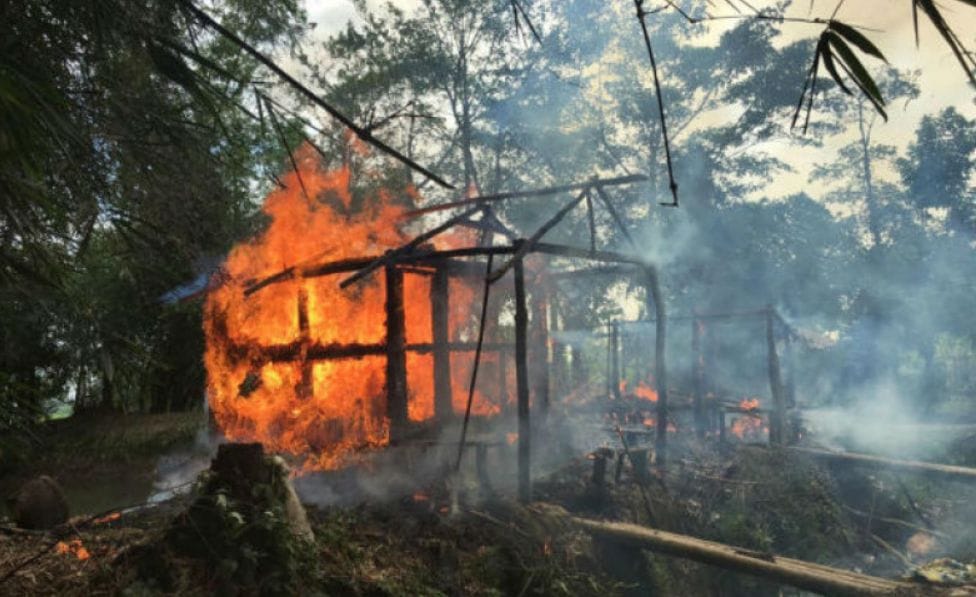
A large fire broke out late Thursday night, almost completely destroying a newly established temporary market near Buthidaung town in Arakan State, causing heavy losses to local traders and residents, according to local officials.
Local sources, citing Arakan Bay News, said the blaze erupted at around 9:50 p.m. on December 19, on the eastern side of the Panzin Creek Bridge, along the northern side of the main road in Buthidaung.
Preliminary information suggests that the fire originated from a blacksmith workshop, possibly due to leftover embers or an unattended fire, which quickly ignited nearby stalls.
The structure of the market, which was largely built with coconut-leaf roofing, contributed to the rapid spread of the flames and made efforts to control the fire extremely difficult.
As a result, shops numbered from 18 to 48 were affected, with at least 28 stalls completely destroyed in the incident.
The temporary market had been recently constructed with support from the Arakan Army, aiming to provide livelihood opportunities for local residents and ensure access to daily necessities.
The destroyed shops belonged to traders from diverse communities, including Rohingya, Rakhine, Hindu, and other ethnic groups, highlighting the multi-ethnic nature of the market.
In connection with the incident, local authorities have opened a case against Shani Kumar, the owner of the blacksmith workshop believed to be the source of the fire.
He has been charged under Section 285 of the Penal Code for negligence involving fire, with the case being handled by the relevant administrative department in Buthidaung.
The incident comes amid difficult humanitarian and economic conditions in northern Arakan State, where many residents rely heavily on temporary markets as a primary source of income and access to essential goods, due to weakened formal trade and damaged infrastructure caused by ongoing conflict.
While such markets are intended to ease living pressures on local communities, poor safety standards and the use of highly flammable materials continue to make them vulnerable to recurring fires, further deepening losses and increasing the fragility of livelihoods in the region.