
Arakan News Agency
The escape journeys undertaken by thousands of Rohingya aboard dilapidated boats across the sea continue, as they flee a harsh reality that has left them with no option but to risk their lives in search of safety and survival from violence and persecution.
While these dangerous journeys represent a last resort to escape the tragic reality they live in, they often end in disasters in the darkness and vastness of the sea, where refugees face the risk of drowning and starvation amid the absence of lasting solutions to their ongoing humanitarian crisis.
Smugglers’ Extortion
The Rohingya are frequently subjected to extortion by human smugglers who exploit their vulnerability, demanding additional sums of money under threats or detention in inhumane conditions that include deprivation of food and water, and exposure to physical and psychological violence, in the absence of any means of protection.
Testimonies from survivors indicate that some of the human smugglers who organize escape journeys departing from Arakan State in western Myanmar belong to Buddhist Arakan militias (the Arakan Army) or groups affiliated with them, exploiting their control over most of the state to organize smuggling operations.
Other smuggling networks are also active in the Teknaf area of Bangladesh, where smugglers exploit the conditions of Rohingya refugees in Cox’s Bazar and their state of despair, smuggling them in exchange for money. Despite the success of Bangladeshi security forces in rescuing a number of Rohingya before being smuggled in recent periods, the phenomenon continues.
Journeys of Death
Over the past year, a number of incidents involving the sinking of dilapidated boats carrying Rohingya migrants beyond their capacity have been recorded, resulting in the drowning of many and the disappearance of hundreds.
Among these incidents was the death of 73 Rohingya refugees by drowning in the Bay of Bengal while heading to Thailand in November of last year, after three boats departed, each carrying 70–80 migrants. One boat sank, another was detained by Thai authorities, while the third managed to reach Malaysia.
Only a few months later, another incident occurred involving a boat carrying 60–70 Rohingya after departing Myanmar en route to Bangladesh. It sank off the coast of Teknaf last March, with only 25 migrants surviving and dozens reported missing. The rescue operation also witnessed the death of a Bangladeshi border guard soldier.
The greatest tragedy came last May, when two boats sank off the coast of Myanmar in two tragic incidents that resulted in the deaths of approximately 427 Rohingya. The United Nations High Commissioner for Refugees described the two incidents as “the deadliest.”
In November last year, a boat carrying about 70 migrants sank near the maritime border between Malaysia and Thailand. Search operations resulted in the recovery of 36 bodies (29 in Malaysia and 7 in Thailand), the rescue of 14 survivors, and the disappearance of dozens. Investigations revealed that the ill-fated boat was one of three boats carrying around 300 migrants that had departed Myanmar, while the fate of the other two boats remains unknown.
An Unknown Fate
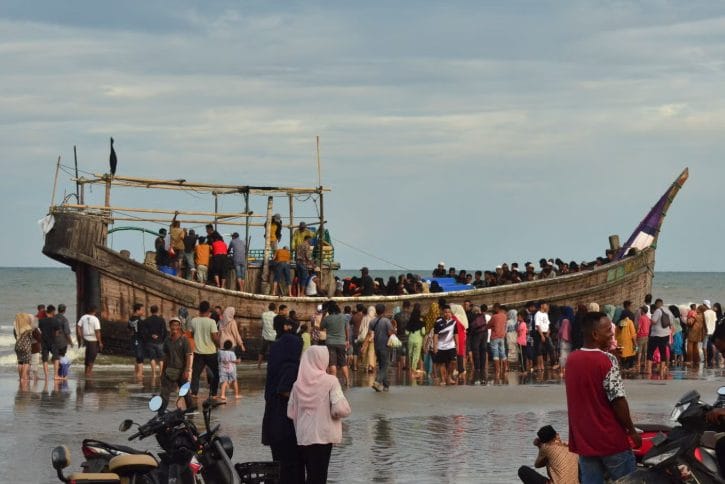
Even when some boats reach shore safely—on rare occasions—the Rohingya find themselves facing an unknown fate between detention or living without legal protection. This occurred last January when 264 Rohingya refugees arrived in Indonesia after Malaysian authorities refused to allow them to dock and pushed them outside the country’s borders.
Indonesian authorities decided to transfer them to a temporary shelter in the Aceh region, which had previously hosted Rohingya refugees who arrived earlier, only for them to find themselves once again under detention.
The situation was not much different in Sri Lanka, which detained 115 Rohingya refugees at a military base after they arrived in the country aboard a boat in December 2024. This prompted the UNHCR to contact the Sri Lankan Ministry of Foreign Affairs in August last year, calling for progress in the refugee registration process to allow for the release of the Rohingya from detention.
Official Figures
According to a joint statement by the United Nations High Commissioner for Refugees and the International Organization for Migration, more than 5,300 Rohingya boarded boats to leave Myanmar and Bangladesh between January and November 2025. More than 600 of them were reported dead or missing, while data indicate that more than two-thirds of the migrants were women and children.
The UNHCR stated that nearly one in five people attempting these perilous sea journeys has been reported dead or missing in the Andaman Sea and the Bay of Bengal, making them among the most dangerous routes in the world.
International Organizations
The UNHCR affirms that the lack of funding exacerbates the difficult humanitarian conditions faced by the Rohingya and forces thousands of them to undertake dangerous sea journeys in search of safety and protection. It noted that Rohingya refugees in Bangladesh, India, Indonesia, and Malaysia, as well as internally displaced persons in Myanmar, required $383 million during 2025, of which only 30% had been secured by last May.
Rohingya Organizations
Twenty-six Rohingya organizations condemned the boat sinking incidents, considering them a continuation of the tragedy endured by the Rohingya, as the victims were displaced due to the conflict in Arakan State and fled violence by Arakan militias (Buddhist separatists), which amounts to a continuation of the genocide committed by the Myanmar army in 2017.
These deadly journeys remain a symbol of the Rohingya’s resilience in the face of violence and persecution that began in 1982 with their deprivation of citizenship under the Citizenship Law and the imposition of restrictions on education, employment, and healthcare, followed by violent campaigns against them, as occurred in 2012 and 2017.
These journeys embody one of the most severe humanitarian crises, reminding the world of the fragility of their situation and the absence of protection, as they continue to risk their lives in search of safety—leaving refugees trapped between death at sea or an unknown fate on land.
As a result of the ongoing persecution of the Rohingya in Arakan State, more than one million have fled in recent years after the Myanmar army launched a genocidal campaign against them in 2017, followed by a military campaign by Buddhist Arakan militias to seize control of the state in November 2023, which also subjected them to violence, displacement, and forced recruitment. Most now live in overcrowded camps in Bangladesh, while some seek to move to other countries in search of better living conditions.


