
Arakan News Agency
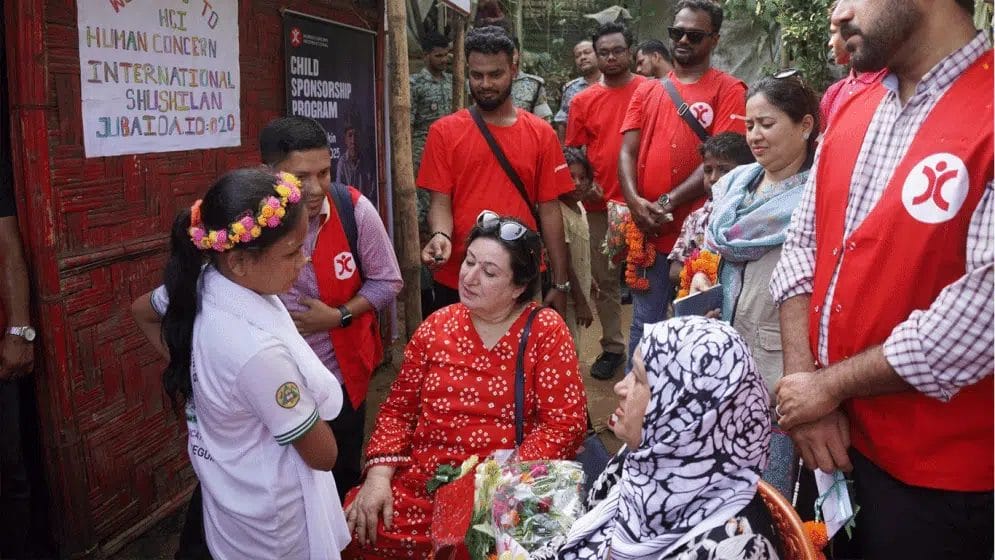
A high-level delegation of Canadian parliamentarians visited the Rohingya refugee camps in Cox’s Bazar, Bangladesh, on Sunday to witness the refugees’ conditions firsthand and to carry their voices and concerns to Canadian policymakers, at a time when international aid is declining.
The delegation included Senator Salma Ataullahjan, Member of Parliament Salma Zahid, and Member of Parliament Sameer Zuberi, who held direct meetings with families, children, youth, and community leaders, observing the humanitarian and security challenges facing the refugee communities, according to Daily Sun.
During the visit, the delegation heard clear demands from the Rohingya, including the right to a safe and dignified return to Myanmar, access to education for children, protection from human trafficking, and the pursuit of long-term solutions beyond emergency aid.
MP Salma Zahid expressed deep emotion after listening to a young Rohingya man speak about his people’s desire to return to their homeland, noting that refugees do not wish to remain in camps forever, but are seeking dignity, safety, and a future.
MP Sameer Zuberi warned of the growing risk of human trafficking within the camps, after hearing testimonies from young women and survivors, describing it as a “crisis within a crisis” that requires urgent international action.
One of the most poignant moments of the visit was a 14-year-old girl sharing her dream of becoming a teacher and her fear that lack of education could make her dream impossible, saying, “The world has forgotten us… we also want a future.” Senator Ataullahjan pledged to convey her story to the Canadian Senate.
The visit was organized under the leadership of Human Concern International and Human Concern USA, which emphasized the importance of “humanitarian diplomacy” engaging policymakers directly in the field rather than only funding programs remotely.
Masum Mahbub, CEO of Human Concern USA, described the visit as a turning point in how North American humanitarian actors engage with crises, stressing that bringing the victims’ voices directly to decision-makers is key to crafting fairer and more effective responses.
Mahmuda Khan, Global CEO of Human Concern International, highlighted that the Rohingya crisis is not only about aid, but also about dignity and livelihoods, stressing that while much of the world has moved on, refugees remain trapped in uncertainty.
It is worth noting that around one million Rohingya have been living in Cox’s Bazar camps since fleeing persecution in Myanmar, representing one of the largest refugee crises in the world. Bangladesh currently hosts approximately 1.3 million Rohingya refugees in Cox’s Bazar, the largest refugee camp in the world according to the United Nations. The refugees continue to live in difficult humanitarian conditions following the 2017 campaign of “genocide” conducted by the Myanmar military, with renewed waves of displacement into Bangladesh since fighting erupted in Arakan State in November 2023 between the Myanmar army and Arakan Buddhist militias (Arakan Army).


