
Arakan News Agency
Bangladesh needs to provide “strong and unassailable evidence” backed up by documents to make its case as a high-profile delegation of the UN Security Council is set to visit Rohingya camp on Sunday, says an international analyst.
“Of course, the refugees are incontrovertible proof of persecution and ethnic cleansing, but thus far it hasn’t been enough,” Ali Riaz, a distinguished professor of Political Science, Illinois State University, USA told UNB.
He said the UN should understand it has a stake, too.
“Thus far, it has failed [to deal with] Rohingya refugees. It’ is unconscionable and it cannot be continued any longer.”
Professor Riaz said, “Hopefully the cycle of inaction will be broken.”
Bangladesh is stressing the need for keeping up pressure on Myanmar from different levels for resolving the Rohingya crisis, an official said, adding that the government remained engaged globally.
Asked about the importance of UNSC team’s visit, he said the importance of the UNSC visit to Bangladesh and Myanmar cannot be overstated.
He said the visit should have taken place a long time ago but Myanmar’s refusal had precluded it.
“It has stakes for Bangladesh and the UNSC. The stakes are higher for Bangladesh as it will be on Bangladesh to sway the members of the UNSC to act,” professor Riaz explained.
Myanmar, on the other hand, according to professor Riaz, will be happy with the status quo.
The analyst said since the crisis began Bangladesh’s diplomatic efforts have been largely reactive, and it did not do very well in shaping the course of the actions of the international community either.
“Bangladesh has to provide strong and unassailable evidence backed up by documents to make its case,” he said.
Whether it will succeed or conversely more pressure will be exerted on Myanmar depends on Bangladesh’s strong diplomatic efforts as a follow-up to the UNSC trip, professor Riaz said.
“I’m afraid that Myanmar may use this as a public relation ploy and try to push the issue off the agenda of international community,” he said.
Professor Riaz observed that reactive posture of Bangladesh and the bilateral agreement with Myanmar have not produced any tangible results.
He said the appointment of a Special Envoy on Myanmar by the UN Secretary General is a positive development and indicates the willingness of the UN to continue its efforts.
United Nations Secretary-General Antonio Guterres on Thursday announced the appointment of Christine Schraner Burgener of Switzerland as his new special envoy on Myanmar.
Burgener brings over 25 years of experience in diplomacy having served in various high-level government positions in the Swiss Federal Department of Foreign Affairs.
Bangladesh currently has a Rohingya population, which is far more than Bhutan’s entire population. Bhutan has around 800,000 people whereas Bangladesh had to give shelter to some 1.2 million Rohingyas.
Meanwhile, according to expatriates’ welfare and overseas employment minister Nurul Islam, at least 200,000 Rohingyas went aboard with Bangladeshi passports and they are earning there and sending money to Myanmar.
Bangladesh and Myanmar signed the repatriation agreement on 23 November 2017. On 16 January, Bangladesh and Myanmar signed a document on ‘Physical Arrangement’ which will facilitate the return of Rohingyas to their homeland from Bangladesh.
The ‘Physical Arrangement’ stipulates that the repatriation will be completed preferably within two years from the start of repatriation.
The high-profile delegation of the UN Security Council arrived in Cox’s Bazar district on Saturday afternoon to see the brutalities that the Rohingyas faced in Myanmar’s Rakhine state and steps taken by the government of Bangladesh.
UNSC president for April Gustavo Meza-Cuadra is leading the delegation, says an official.
They will stay at Royal Tulip Hotel on Inani beach, Cox’s Bazar and will visit Kutupalong Rohingya camp in the district on Sunday to see first-hand the impacts of the Rohingya crisis.
State minister for foreign affairs M Shahriar Alam and acting foreign secretary retired rear admiral Khurshed Alam are now in Cox’s Bazar to accompany the UNSC team.
The delegation members will leave hotel for Kutupalong Rohingya camp at 8:20am Sunday and at first they will go to no man’s land along the Bangladesh-Myanmar border.
They will talk to Rohingyas in various blocks in Kutupalong camp and brief media at 12:45pm at the camp on Sunday.
The UNSC team is scheduled to leave Cox’s Bazar for Dhaka at 3:30pm on Sunday.
They are scheduled to meet prime minister Sheikh Hasina at Gonobhaban at 9:30am on Monday and will leave Dhaka at 10:30am for Naypyidaw and go to Arakan the next day.
The UN Security Council is composed of 15 members with five permanent members — China, France, Russian Federation, the United Kingdom and the United States — and 10 non-permanent members.
The UNSC visit was originally scheduled for 27-28 April.
Earlier, Bangladesh urged the UN Security Council to visit Myanmar and Bangladesh to witness the humanitarian situation of the Rohingyas amid continuous influx of the refugees.
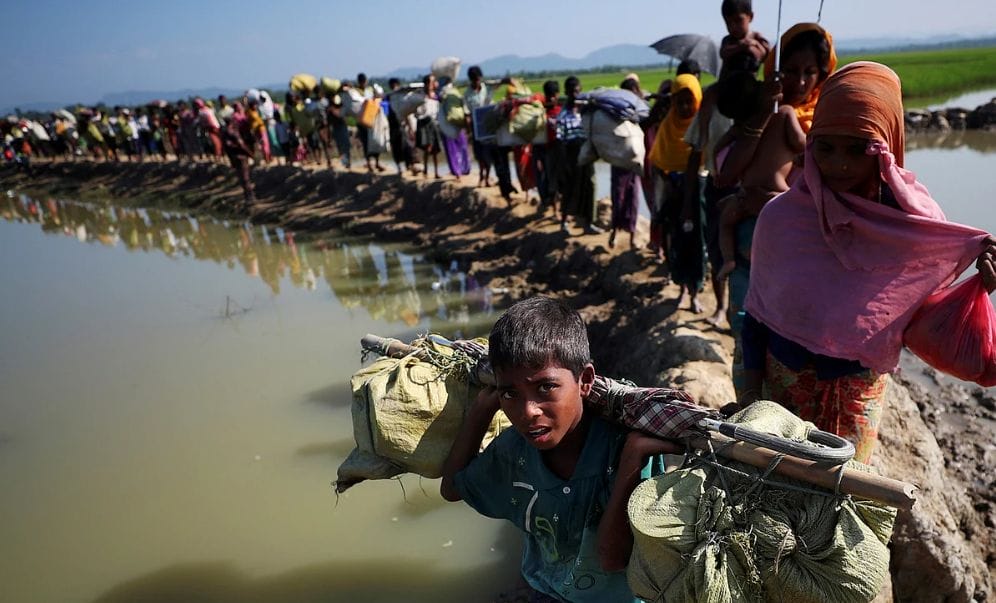
Over 700,000 Rohingyas fled to Bangladesh, and the influx, though reduced in recent weeks, continues despite Myanmar’s assurances of stopping violence in Rakhine.
On 6 April, Hasina invited UN Secretary-General Antonio Guterres to visit Bangladesh to see for himself the plight of Rohingyas who have taken shelter in Bangladesh amid persecution in Myanmar.
During the telephone conversation, she also sought UN cooperation in implementing the agreement signed between Bangladesh and Myanmar over the Rohingya repatriation.


