Arakan News Agency
Edited by: Tahany Ali
Correspondent: Mohamed Radwan
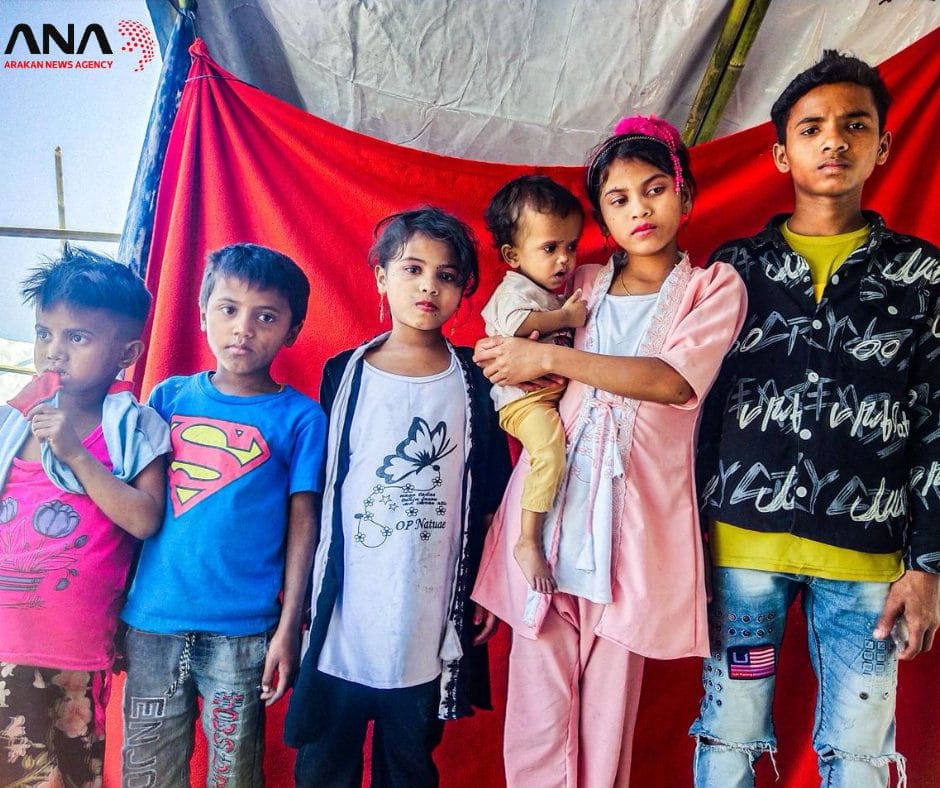
In a narrow corner of Camp 16 in Cox’s Bazar, Bangladesh, 13-year-old Kayas sits carrying a burden far heavier than his age. No longer just a Rohingya refugee child, Kayas has suddenly become the head of a family of six, responsible for five younger siblings — the youngest, Shafida, is only 14 months old — after a series of tragedies that began with their father’s forced arrest and ended with a fire that destroyed what remained of their shelter.
War, illness, and fire
Tens of thousands of Rohingya children are living in refugee camps in Bangladesh without one or both parents, or without adequate family care, in what the United Nations High Commissioner for Refugees (UNHCR) describes as one of the world’s most protracted and complex humanitarian crises.
Against this harsh backdrop, the story of Kayas and his five siblings highlights the extreme vulnerability faced by Rohingya orphans inside the camps. The children had been living with their mother in their maternal grandmother’s shelter after fleeing Myanmar in search of safety. During their displacement, their father was arrested by Arakan militias (Buddhist separatist groups), according to Kayas. Since then, the family has received no information about his fate.
After arriving in Bangladesh, the mother became the sole caregiver for the six children. She died following a long illness about two weeks ago. Only days after her death, a major fire broke out in the camp, destroying the family’s temporary shelter and stripping the children of what little sense of security they had left.
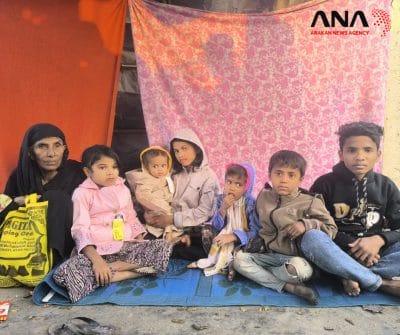
The six siblings — Kayas (13), Ashika (11), Shaika (9), Anwar (7), Asma (5), and Shafida (1 year and 2 months) — are now under the care of their elderly grandmother, who has limited physical ability and almost no resources, as she struggles to keep the family together under extremely harsh living conditions.
Alarming figures
According to UNHCR, more than one million Rohingya refugees are living in Cox’s Bazar camps, with children making up about 52 percent of the population.
UNICEF estimates that thousands of children in the camps are living without one or both parents due to killings, enforced disappearances, disease, fires, and landslides — recurring risks in the overcrowded camps with poor infrastructure. A previous assessment identified more than 6,000 children as either unaccompanied or separated from their families, a figure that continues to rise amid repeated fires and security disruptions.
One in eight children in the camps suffers from acute malnutrition, placing infants like Shafida at serious risk in the absence of adequate family care. UNICEF warns that unaccompanied and separated children are among the most vulnerable groups, facing heightened risks of exploitation, violence, and neglect due to limited resources, insufficient safe spaces, and immense pressure on child-protection systems.
Support and protection mechanisms
UNHCR, in coordination with the Government of Bangladesh and its UN and humanitarian partners, implements specialized child-protection programs in the camps. These include the registration of orphans and separated children, alternative care arrangements, psychosocial support, non-formal education, food assistance, and basic health services.
UNICEF operates child-friendly spaces and provides psychosocial and educational support, while Bangladeshi authorities, through the Office of the Refugee Relief and Repatriation Commissioner (RRRC), oversee humanitarian coordination and access to aid.
However, the United Nations has repeatedly warned that chronic funding shortages pose a major challenge. Child-protection programs face widening gaps, limiting the ability to respond to growing needs as the Rohingya crisis enters its ninth year.
An uncertain future
The tragedy of Kayas and his siblings reflects the reality faced by thousands of Rohingya children who have grown up in camps without ever knowing stability or safety.
“We just want a safe place to sleep, and that no one separates us,” Kayas said quietly, his words far beyond his years. This simple wish clashes with the reality of declining international funding for the Rohingya response, as UN appeals for humanitarian assistance remain only partially funded.
Each child in the camps is more than a statistic — they represent lives at risk and a shared international responsibility that requires sustained global support until durable solutions ensure dignity and basic rights for Rohingya refugees.
As long as there is no clear path toward safe, voluntary, and dignified return to Arakan State, the protection, education, and care of Rohingya children remain an urgent humanitarian and moral challenge — one that cannot afford to be ignored.