
Arakan News Agency
“When all the banners are lifted and the siren goes up to the maximum, it is the strongest warning,” explains a trainer from the Bangladeshi government’s hurricane prevention program for a class of volunteer Rohingya refugees.
In pursuit of disaster risk reduction, Bangladesh launched the program several decades ago. Today, for the first time, it is being launched in the vast camps in south-eastern Bangladesh, where some 600,000 Rohingya refugees now live.
“The information in this training is very important to us”
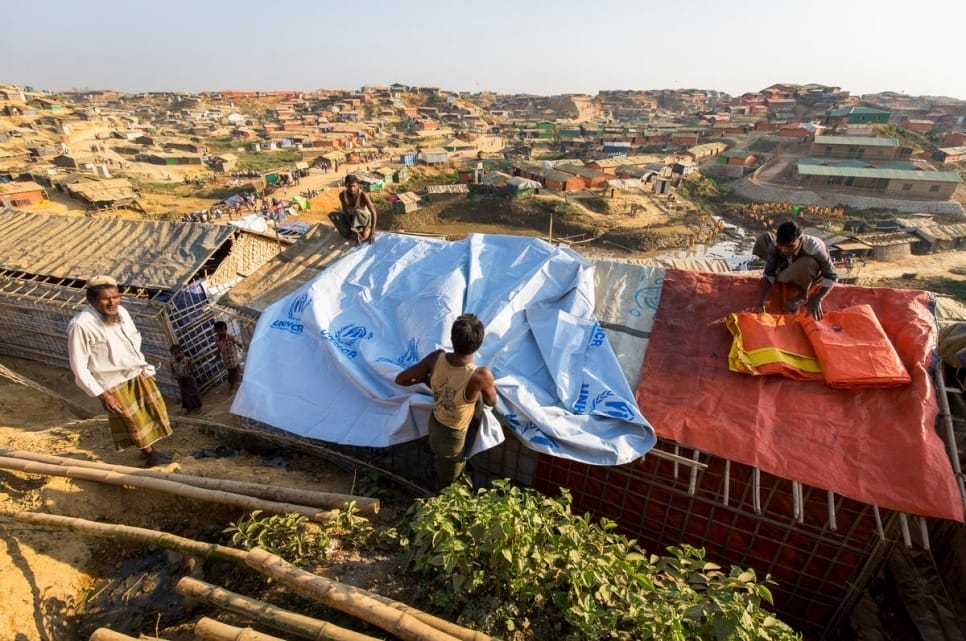
Families live in shanty, bamboo-covered shacks in the densely populated Kutupalong and Nayapara camps that are already at risk of landslides and floods during the rainy season, culminating between June and September.
There is also the danger of hurricanes, strong storms with heavy rains, high winds and a humid storm that causes landslides in Bangladesh almost every year between March and December.
AbdulMustafa, a Bangladeshi government official in the southernmost region of Bangladesh, which includes the Kutupalong and Nayapara camps, explains that the government and partners are working together to avoid a disaster during the rainy season.
“That’s why we launched the hurricane prevention program in the refugee areas led by the Bangladeshi government and with the support of our partners,” Mustafa said.
The Bangladeshi government has developed considerable experience in dealing with cyclones, with 154 cyclones hit the coast since 1877, including Hurricane Gorki in 1991, which caused the highest number of deaths, with 139,000 people killed in southeastern Bangladesh.
As the rainy season approaches this year, the Bangladeshi government program is receiving support from UNHCR, other United Nations agencies and humanitarian partners.
“The information in this training is very important for us to know what we can do as storms approach,” said Gamalida, a 35-year-old volunteer who was involved in the training. If there are ways we can help ourselves and each other, such as the response methods when we hear the hurricane’s arrival, we have to learn it! “
Recently, Mustafa, who is leading the program launch in the region, visited the camp and watched the trainers while they were working. He explained that the Bangladeshi Government was keen to help build skills to create an environment conducive to maintaining safety and preventing serious injuries and losses.
Training sessions within government offices surrounded by bamboo frames in the large and metropolitan Kutupalong camp are essential to the implementation of the program. Each training session includes 20 participating volunteers with equal numbers of men and women.
“Nearly 480 volunteers have been trained so far”
The aim of this training is to raise awareness about the devastating risks of tropical cyclones and to show how individuals and groups respond when a hurricane occurs and losses occur.
“The idea is to give each of the 20 volunteers an appropriate understanding of prevention and skills so that they can spread their information throughout the camps,” says Mustafa. About 480 volunteers have been trained so far and there will be more. “
There are three ways to assist those in need, according to WFP trainers, preventive measures such as relocation, first aid and health referral, and the distribution of essential relief items.
“There are thousands of families who build their shelters without realizing the dangers of the rainy season on the lowlands. These families are encouraged to move to higher altitudes to avoid the worst impacts of rain and wind. “
The hurricane prevention trainers teach skills and provide the necessary information to respondents from the first response line, through simulation exercises, plays and songs.
“We encourage participants to use their skills to find alternatives if they know the necessary steps, so they can manage things even if they can not get the equipment they need when a disaster happens for any reason. If they do not have a loudspeaker to declare an approaching catastrophe, for example, they can resort to an alternative, such as announcing emergency situations from a nearby mosque. “
Volunteers receive equipment, including gloves, rubber boots, helmets, sirens and lamps. Participants welcomed the training that had been organized with the first rainfall, which caused flooding and diverted land to and around.
Since the launch of the program in Bangladesh, cyclone deaths have dropped dramatically. It is hoped that the risk of significant losses will be reduced by introducing training to refugee camps.
Being able to think in alternative ways quickly and understanding how risk reduction and prevention can help refugees reduce the likelihood of loss.


