
Arakan News Agency
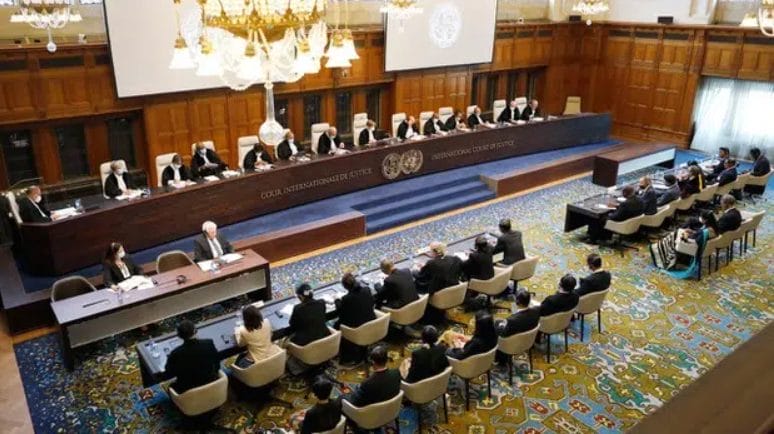
The International Court of Justice (ICJ) in The Hague has begun hearing a landmark case filed by The Gambia against Myanmar, accusing the country’s leadership of deliberately attempting to exterminate the Rohingya during a military crackdown carried out by the Myanmar army in 2017.
The court’s hearings are scheduled to last three weeks and will include oral arguments from both sides, examination of evidence, and live testimony from witnesses and experts, to determine whether Myanmar violated the United Nations Convention on the Prevention and Punishment of the Crime of Genocide, to which Myanmar is a party.
Background of the Case and The Gambia’s Arguments
The Gambia first filed the case in 2019, relying on credible reports indicating that Myanmar’s army committed brutal and vicious violations against the Rohingya. Gambia’s Minister of Justice and Attorney General, Dawda Jallow, said the Rohingya had endured decades of systematic persecution and dehumanising propaganda, followed by military campaigns and ongoing genocidal policies aimed at erasing their existence in Myanmar.
The Gambia’s lawyer, Tafadzwa Pasipanodya, presented shocking testimonies showing that Myanmar soldiers carried out “door-to-door” operations involving the killing of elderly people, the gang rape of women and girls, and the throwing of infants into rivers, before burning villages to the ground during what were described as “clearance operations.”
Pasipanodya added during the hearings: “All of this evidence taken together convincingly shows that Myanmar, through its state institutions, acted with the intent to destroy the Rohingya.”
Myanmar’s Position
Myanmar justified the actions of its army by claiming they were aimed at eliminating insurgents following a series of attacks that killed security personnel, asserting that its campaign was “justified.” Myanmar’s lawyers are expected to begin presenting their arguments on Friday.
Impact of the Campaign on the Rohingya
The military operations forced hundreds of thousands of Rohingya to flee to Bangladesh, where approximately 1.17 million people now live in overcrowded and dilapidated camps in the Cox’s Bazar area. Thousands of others remain displaced or trapped inside Myanmar, amid ongoing violations and a severe lack of legal protection.
Legal and International Process
The court’s final ruling may take several months or longer. Although the International Court of Justice has no mechanism to enforce its decisions, a ruling in favour of The Gambia would significantly increase political pressure on Myanmar.
This is the first genocide case heard by the court in more than a decade and is expected to influence how future cases are assessed, including South Africa’s case against Israel over its military campaign in Gaza.
Significance of the Case
This case represents a major step in international justice, as it goes beyond determining legal responsibility for crimes to send a strong message about holding states accountable for violations against minorities and protecting vulnerable communities from systematic violence and genocide. It also provides an opportunity to shed light on the decades-long suffering of the Rohingya, the humanitarian and social experiences of survivors and refugees, and serves as a reminder to the international community of the need to confront violations against minorities.
It is noteworthy that The Gambia first submitted the application in November 2019, accusing Myanmar of breaching the Genocide Convention. A UN Human Rights Council–mandated fact-finding mission reported in 2018 that there were reasonable grounds to conclude that serious crimes under international law had been committed, including genocide, war crimes, and crimes against humanity.
The Gambia’s pursuit of justice is supported by 57 member states of the Organisation of Islamic Cooperation, as well as 11 other countries, including the United Kingdom, France, Germany, and Canada.


